Brain Death Is No Longer the End
The question of death and the boundaries of human consciousness is one of the deepest philosophical and medical challenges.
Clinical death was long considered the irreversible end of life. However, research over the past decades, especially those conducted at Yale and Harvard, has shown that the brain and organs can retain cellular activity for hours after death.
These discoveries open new questions about the definition of death, the possibilities of resuscitation, and the role of technologies such as brain-computer interfaces (BCI), as well as new issues of ethics and regulation of neural data.
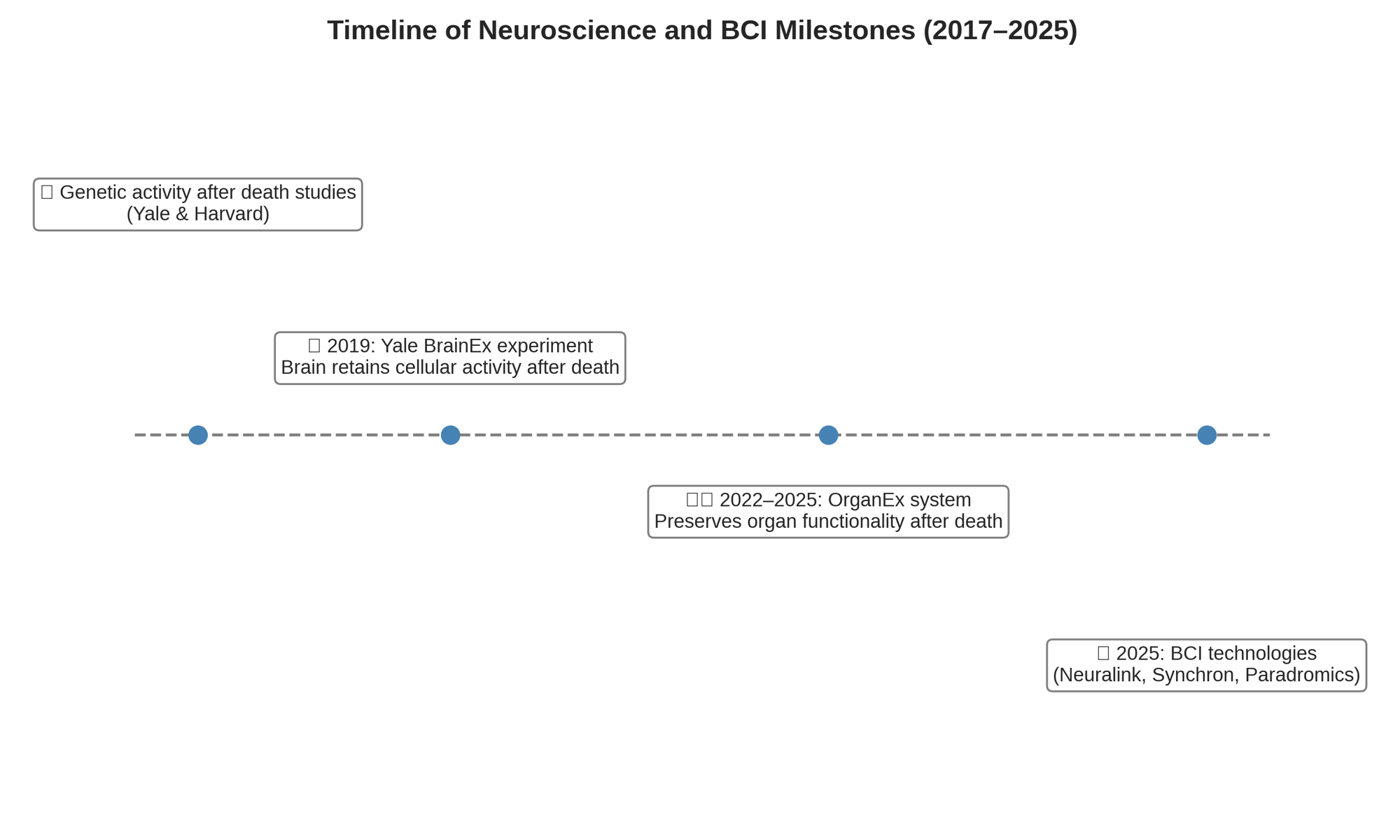
The first proof that brain death is not immediate and irreversible was the Yale BrainEx Experiment (2019), when a team of scientists at Yale School of Medicine, led by Nenad Sestan, published the results of a revolutionary experiment and demonstrated that the brain can retain cellular activity for hours after death, although without consciousness.
Results:
- Neurons showed signs of activity.
- Synapses reestablished communication.
- Circulation was restored.
There were no signs of organized electrical activity that would indicate consciousness.
OrganEx System (2022–2025)
Building on BrainEx, the Yale team developed OrganEx, a system applied to the whole body. The goal was to preserve organ functionality after death. OrganEx proved that the body after clinical death can retain organ functionality, opening a new dimension in medicine.
- The heart was restarted.
- Kidneys continued filtering.
- The liver showed metabolic activity.
All of this lasted up to six hours after death.
These results have enormous implications for transplant medicine. Organs can be preserved longer, increasing the chances of successful transplants.
Genetic Activity After Death (Studies 2017–2025)
Research at Yale and Harvard showed that certain genes activate after death. In some cases, up to 1,000 genes showed increased activity between 30 minutes and 48 hours after death.
This activity indicates that death is not an immediate cessation of all biological processes. Instead, there is a transitional state in which cells and genes continue to function. Genetic activity after death further confirms that death is a complex process, not a single event.
Brain-Computer Interfaces (BCI) up to 2025
Technologies BCI systems such as Neuralink, Synchron, and Paradromics have been developed to enable communication between the brain and computers.These systems rely on sophisticated neural network architectures to decode brain signals in real-time. Read: Understanding Artificial vs Spiking Neural Networks: Which architectures power modern BCIs?
Applications
- ALS patients use BCI to control devices with their thoughts.
- People with paralysis can communicate through thought signals.
Limitations
- BCI currently cannot preserve consciousness.
- They capture signals from the motor cortex but do not transmit full consciousness.
- BCI has proven useful in medicine, but its role in preserving consciousness after death has not yet been confirmed. However, the integration of BCI systems with advanced robotics is already demonstrating remarkable possibilities for restoring motor function and communication in paralyzed patients: The Future of Neuro‑Robotics: How BCI systems control robotic limbs and restore mobility see here
Ethics and Regulation of Neural Data
Neural Privacy Neural data is becoming a new dimension of privacy. The EU AI Act classifies BCI as high-risk technology.
- Emotion recognition without consent is prohibited.
- Penalties can reach up to 7% of a company’s global turnover.
This regulation shows that society recognizes the importance of protecting neural data. Ethics and regulation of neural data are becoming key aspects of BCI development.
Proven Findings
Yale and Harvard research has shown that the brain and organs can retain functionality for hours after death. BCI technologies have proven helpful for patients with neurological diseases, but they cannot preserve consciousness after death. Ethics and regulation of neural data are becoming increasingly important.
New Questions Crucial for Understanding the Implications of Scientific Discoveries
Identity If brain activity is preserved but not consciousness, the question arises: is this still “life”?
Moral Status If BCI one day succeeds in preserving consciousness, will that consciousness have moral status?
The realization that death can no longer be seen as an immediate end, but rather as a process, changes medicine, philosophy, and ethics.